A special right triangle is a right triangle with some regular feature that makes calculations on the triangle easier, or for which simple formulas exist. For example, a right triangle may have angles that form simple relationships, such as 45°–45°–90°. This is called an 'angle-based' right triangle. Visit www.doucehouse.com for more videos like this. In this video, I explain the basics behind the 45-45-90 and 30-60-90 special right triangles. The two special right triangles are as important to Trigonometry as arithmetic is to mathematics. On this page you will find the information you need to understand the relationships they have between their sides and angles, as well as plenty of practice helping you learn to apply those relationships to find missing information. Lesson 8-2 Special Right Triangles 427 To prove Theorem 8-6, draw a 308-608-908 triangle using an equilateral triangle. Proof of Theorem 8-6 For 308-608-908 #WXY in equilateral #WXZ, is the perpendicular bisector of.
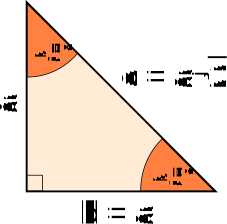
As we know, a right triangle is a triangle whose one angle always measures 90°. The longest side opposite of a right triangle is called the hypotenuse, while the horizontal leg is called the base and the vertical leg is called the height or the altitude.
What is a Special Right Triangle

Special right triangles are right triangles whose angles or sides are in a particular ratio. They have some regular features that make calculations on it much easier.
In geometry, the Pythagorean Theorem is commonly used to find the relationship between the sides of a right triangle, given by the equation: a2 + b2 = c2, where a, b denotes the height and base of the triangle and c is the hypotenuse. But, if it is a special right triangle, we can use simpler formulas.
Special Right Triangles Khan Academy
Some common special right triangles are shown below.
Types of Special Right Triangle
The two most common special right triangles are:
45-45-90 Triangle
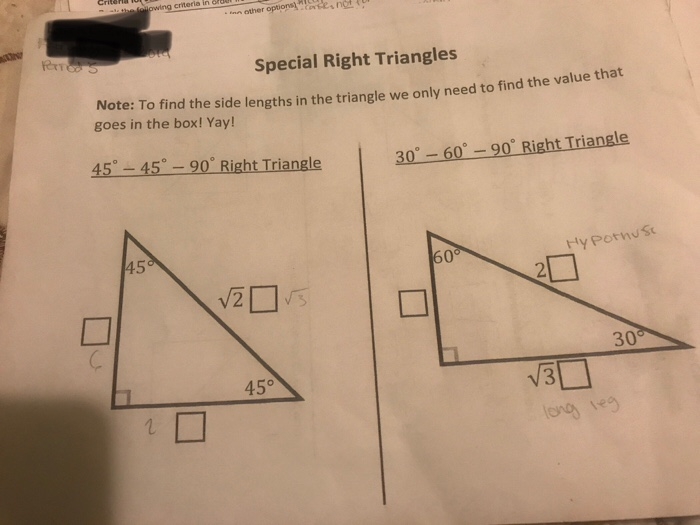
A 45-45-90 triangle is a special right triangle whose three angles measure 45°, 45° and 90°. The ratio of its side lengths (base: height: hypotenuse) is 1: 1: √2.

30-60-90 Triangle
A 30-60-90triangle is a special right triangle whose three angles measure 30°, 60° and 90°. The ratio of its side lengths (base: height: hypotenuse) is1: √3: 2.
Apart from the above two types, there are some other special right triangles.

Others: Pythagorean Triples
Some right triangles have sides that are of integer lengths and are collectively called the Pythagorean triples. Such triangles can be easily remembered and any multiple of the sides produces the same relationship. Pythagorean triples can be of three types:
- Common Pythagorean triples: Sides with integer lengths. Examples – 3-4-5, 5-12-13, 8-15-17, 7-24-25, and 9-40- 41.
- Almost-isosceles Pythagorean Triples: Sides with integer lengths but almost isosceles. Examples – 20-21-29, 119- 120-169, 696-697-985, and 4,059-4,060-5,741.
- Sides that are in Geometric Progression: Also known as the Kepler triangle, if the sides are in geometric progression a, ar, ar2, its common ratio r is given by r = √φ where φ is the golden ratio.
Formulas
Although there is no common formula for special right triangles, each of them has specific formulas for finding the missing sides, area, and perimeter based on the ratio of their side lengths. Find their formulas with solved examples in our separate articles.
How to Solve Special Right Triangles
Solving special right triangles is about finding the missing lengths of the sides. Instead of using the Pythagorean Theorem, we can simply use the special right triangle ratios to find the missing length. Let us understand the concept better by doing some practice problems.
The hypotenuse of a 45-45-90 triangle is 12√2 mm. Calculate the length of its base and height.
As we know,
Ratio of their Side Lengths = x: x: x√2, here x√2 = hypotenuse = 12√2 mm
Thus,
x√2 = 12√2 mm
Squaring both sides we get,
⇒ (x√2)2 = (12√2)2 mm
⇒ 2x2 = 144 x 2 = 288
⇒ x = √144 = 12 mm
Hence, the base and height of the given right triangle measure 16.97 mm each.
The longer side of a 30-60-90 right triangle is given by 5√3 cm. What is the measure of its shorter side and hypotenuse?
As we know,
Ratio of their Side Lengths = x: x√3: 2x, here x = shorter side, x√3 = longer side = 5√3 cm, 2x = hypotenuse
Thus,
x√3 = 5√3
Squaring both sides we get,
(x√3)2 = (5√3)2
⇒ 3x2 = 25 x 3
⇒ x2 = 25
⇒ x = 5 cm
The length of the hypotenuse and the other side of a right triangle are 30 cm and 24 cm, respectively. Find the length of the missing side.
As we know,
Here we have to find whether the sides are in the ratio of 3x: 4x: 5x
Thus,
?: 24: 30 = ?: 4(6): 5(6)
Thus, the sides are in the ratio of 3x: 4x: 5x and it is a 3-4-5 triangle.
For calculating the third side,
For, n = 6
Hence, the length of the other side,
3x = 3 x 6 = 18
Therefore the length of the missing side is 18 cm.
If the two sides of a right triangle are 3 ft and 4 ft, find the length of hypotenuse.
Special Right Triangles Calculator
Special Right Triangles Video
As we know,
Here we have to find whether the sides are in the ratio of 3x: 4x: 5x
3: 4: ? = 3(1): 4(1): ?
Thus, the sides are in the ratio of 3x: 4x: 5x and it is a 3-4-5 triangle
For calculating the hypotenuse,
For, n = 1
Hence, the length of the hypotenuse,
5x = 5 x 1 = 5
Therefore the length of the hypotenuse is 5 ft